
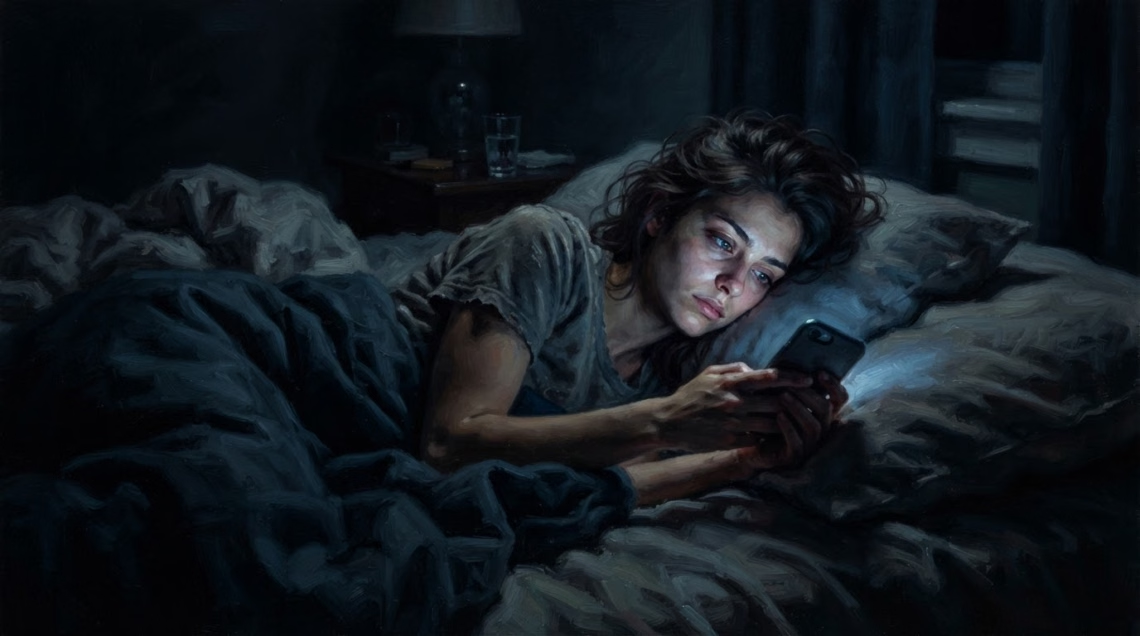
It is 2:18 AM.
The room is pitch black, except for the cold, sharp glow of your phone illuminating your face. Your eyes sting with that dry, gritty burn that only arrives when you have pushed your body past its natural limits. You know with absolute certainty that your alarm is set for 7:00 AM.
You do the math in your head. If I fall asleep right this second, I can still get four hours and forty-two minutes.
And yet, your thumb doesn’t lock the screen. It swipes up again.
You watch a stranger clean a rug. You read a Reddit thread about a family dispute from four years ago. You scroll past three videos you don’t even care about, barely registering the sound. You aren’t even enjoying it. In fact, you feel a dull, sickening guilt pulsing behind your temples with every passing minute.
So why can’t you just close your eyes and go to sleep?
Because you don’t actually have insomnia. And you aren’t addicted to your phone. What you are doing right now is something far more desperate, far more human, and far more heartbreaking.
You are staging a quiet, midnight rebellion to steal your life back.
The Day Belongs to Everyone Else. The Night Belongs to You.
Think about the last fourteen hours of your day. How much of that time actually belonged to you?
From the moment your alarm rang this morning, your life was an endless series of performances for other people. You answered emails with performative cheerfulness. You nodded in meetings you didn’t care about. You managed family expectations, swallowed your irritation in traffic, smiled at coworkers, and said “I’m good, how are you?” sixty times while feeling completely hollow inside.
Psychologists call this Revenge Bedtime Procrastination. It is the psychological phenomenon where people who have little to no control over their daytime schedule refuse to sleep at night in a desperate bid to regain a sense of freedom and personal agency.
You are not staying awake because you have energy. You are staying awake because going to sleep means admitting that the only time you had for yourself today is officially over.
When you close your eyes, tomorrow arrives immediately. Going to sleep is a surrender. It is signing the paperwork that hands you right back over to the alarm clock, the commute, the boss, the responsibilities, and the endless performance of being an adult. Staying awake—even if you are just staring at mindless nonsense—is the only boundary you have left.
The Exhaustion of Being a Person All Day
Most people mistake physical tiredness for soul exhaustion.
You aren’t tired because you ran a marathon or did hard physical labor. You are tired because modern life requires you to be permanently “on.” You are constantly accessible. Every ping on Slack, every WhatsApp message, every notification is a tiny, invisible hand tapping your shoulder, demanding your attention, your reaction, your energy.
In our reflection on the exhaustion of always being the strong one, we talked about what happens to the person who carries everything for everyone else. When you spend the entire day being reliable, composed, and productive, you build up a massive cognitive debt. By 11:00 PM, your brain isn’t asking for rest; it is screaming for autonomy.
Late at night, the world finally shuts its mouth.
Nobody is sending you a work email at 1:45 AM. Nobody is knocking on your door asking where the car keys are. Nobody is asking you to solve a crisis or be a partner or be a child or be a boss. The house is silent. The notifications stop. And for the first time in sixteen hours, you can take a breath without someone asking what you plan to do with it.
That silence is intoxicating. It is so addictive that you are willing to trade tomorrow’s physical well-being just to sit inside it for ninety more minutes.
Why You Scroll Instead of Doing Something Meaningful
Here is the contradiction that makes you hate yourself the most: If I wanted personal time so badly, why didn’t I read a great book? Why didn’t I paint, journal, or meditate? Why did I just waste two hours looking at random strangers on an algorithm?
Because your willpower is completely spent.
Reading a book requires focus. Journaling requires emotional processing. Creating art requires creative energy. But by midnight, you don’t have a single drop of cognitive energy left to invest. In why we inspect life instead of living it, we explored how modern mental noise drains our capacity for real presence.
You don’t scroll because you want entertainment. You scroll because you want anesthesia.
The algorithm doesn’t ask anything from you. It doesn’t ask you to be brave, smart, kind, or successful. It just feeds you light while you hide from the reality of your life.
Scrolling is a low-stakes holding cell. It keeps your conscious mind just occupied enough so that the terrifying, existential thoughts—What am I doing with my life? Am I happy? Why do I feel so lonely?—don’t have enough room to rise to the surface.
The Secret Dread of Tomorrow
If you want to understand why you refuse to sleep, stop looking at the phone in your hand. Look at the life waiting for you when you wake up.
People who love their daily lives don’t stay up until 3:00 AM fighting sleep. They look forward to waking up. They feel excitement about what tomorrow holds. But when your days feel like an endless treadmill of obligations that give nothing back to your soul, sleep feels like stepping onto the executioner’s block.
You dread tomorrow because tomorrow feels identical to today. You feel trapped in the waiting room of your own existence—a feeling we unpacked in why do I feel like my real life hasn’t started yet?. You tell yourself that one day you will have balance, that one day you will have time to breathe, that one day your life will belong to you.
But right now, the only territory you actually own is this rectangle of bed and the dark hours between midnight and sunrise.
How to Stop Sacrificing Tomorrow Just to Survive Tonight
You cannot fix this with a sleep tracker, magnesium gummies, or blue-light glasses. You cannot solve a spiritual rebellion with a productivity hack. If you want to stop destroying your health in the middle of the night, you have to heal the daytime that is starving you.
1. Give Yourself Daylight Sanctuary
If you don’t claim thirty minutes of sacred, uninterrupted time for yourself during the day, your subconscious mind will rob two hours of sleep to get it at night. Take a twenty-minute walk without your phone at 2:00 PM. Sit in your car with a coffee and stare at the sky. Close your laptop and refuse to look at a screen during lunch. Prove to your nervous system that daylight can hold peace too.
2. Stop Being Endlessly Available
Much of the exhaustion that drives late-night scrolling comes from chronic people-pleasing. If you spend the day saying yes to every meeting, every favor, and every demand, you will end the day feeling violated and resentful. As we explored in why do I keep saying yes when I want to say no?, boundaries are not selfish—they are the only thing that keeps you from disappearing.
3. Create an Honest Transition Ritual
When you get into bed with your phone in hand, you have already lost. The bed must become a sanctuary, not a screen theater. Place your charger across the room. When you lie down, let the silence be heavy. Yes, the uncomfortable thoughts will come. Let them. Let yourself feel the grief, the tiredness, the loneliness. You don’t need to run from them with an algorithm.
A Final Word for the One Still Reading in the Dark
If you are reading this right now while the clock flashes 2:00 AM or 3:00 AM, stop for a second.
Don’t judge yourself. Don’t feel ashamed of the hours you gave away. You aren’t broken. You are just a human being who has been carrying too much for too long, trying desperately to find ten minutes of peace in an exhausting world.
Your rebellion is understood. Your exhaustion is real. But stealing hours from tomorrow is not how you save yourself.
Take a deep, slow breath. Drop your shoulders away from your ears. Unclench your jaw. Lock the screen, place the phone down, and let yourself rest. The world will still be there tomorrow—and you deserve to meet it with a whole heart.
A Quiet Companion for the Midnight Hours
If you find yourself awake in the quiet hours wrestling with thoughts you can’t outrun, explore Anudeep Paladugu’s poetry and prose collection, Her Name in Every Silence. A tender reflection on longing, emotional unlearning, and finding peace in the quiet.
Continue the Rabbit Hole
If this reflection mirrored your late-night thoughts, don’t stop here:
- The Exhaustion of Always Being the Strong One: why the person who carries everything struggles to put the shield down.
- Why We Inspect Life Instead of Living It: the rise of modern noise, forgotten roots, and the search for the sacred.
- Why Do I Feel Like My Real Life Hasn’t Started Yet?: stepping out of the waiting room of your own life.
- Why Do I Keep Saying Yes When I Want to Say No?: unlearning the habit of making your peace negotiable.

Anudeep Paladugu is a writer and author of Her Name in Every Silence and No Record of Her. He writes honest, unedited reflections on emotional recovery, love, and the human experience.