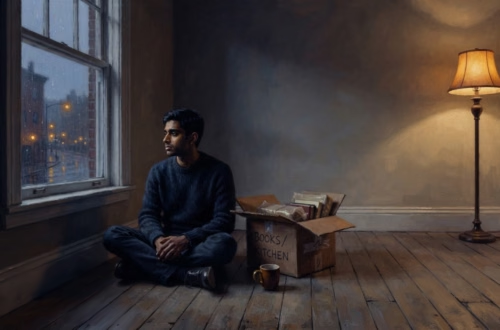
Rajesh had grown up among brass lamps, cracked porcelain, and shelves that smelled of teak oil. His grandfather had spent forty years buying oddities from estate sales and coastal auctions, and when the old man passed away, Rajesh kept the little corner antique shop running with the same stubborn care. He liked objects that carried quiet histories, things that had survived two or three owners before landing on his counter.
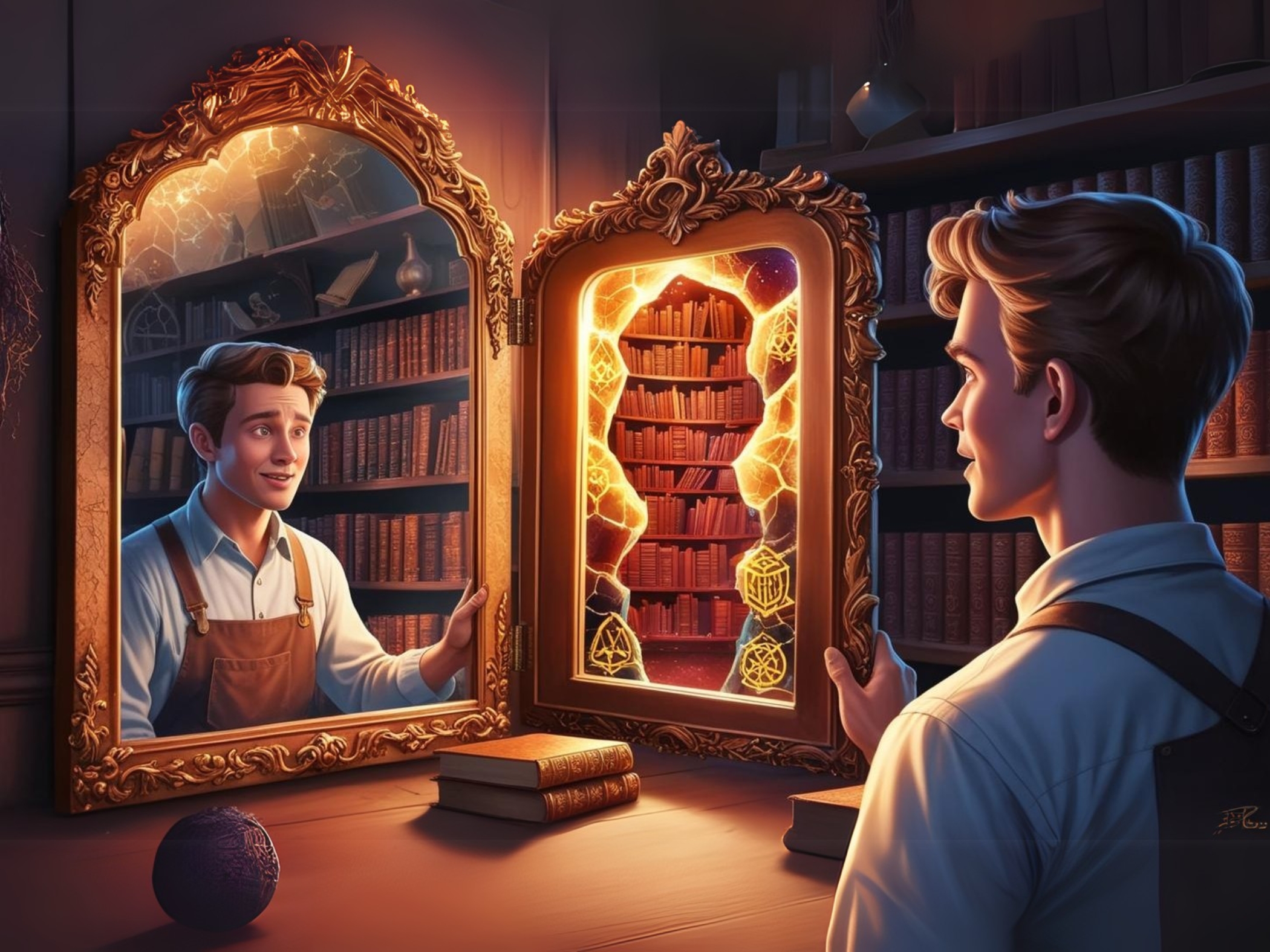
One Tuesday afternoon, a delivery van left a tall wooden crate outside the shop. There was no return address on the shipping slip, only Rajesh’s name and the shop’s street number. After prying off the pine slats with a crowbar, he pulled away layers of packing straw and found a heavy oval mirror. Its mahogany frame was carved with tangled vines and small songbirds, worn smooth along the bottom edge by hands from another century.
Assuming it had come from one of his grandfather’s old contacts, Rajesh cleared space on the back wall and hung it beside a row of pocket watches. At first, it looked like any fine antique glass, slightly wavy at the edges and dim in the corners.
The next morning, while sweeping near the counter, Rajesh caught movement in the mirror out of the corner of his eye. He turned around expecting a customer, yet the bell over the shop door had not rung. Inside the glass, his own shelves had vanished. Instead, he saw a sunlit dirt lane crowded with vendors shouting over wicker baskets of mangoes and clay pots. A man in a crumpled linen shirt walked straight toward the glass and vanished before Rajesh could blink. When he stepped closer, only his own startled face stared back.
Over the following week, the mirror refused to stay still. In the evenings, when streetlamps flickered outside, the glass shifted through scenes of the town long before Rajesh was born: a brass wedding band passing under strings of marigolds, a quiet funeral procession moving through monsoon rain, lanterns floating down the river during an old festival. Customers noticed it too. An elderly woman stopped mid-sentence while haggling over a silver tray, stared into the oval frame, and whispered her grandmother’s name before hurrying out into the street.
On the tenth day, a thin man in a dust-stained coat walked through the front door without looking at the displays. His eyes went straight to the back wall. When he saw the carved songbirds along the mirror’s frame, he let out a shaky breath.
“I have been tracking that frame for three months,” the stranger said, keeping two paces back from the glass. “You need to cover it with a sheet and lock it in your back room. That is not a mirror. It is a door into the Hidden Library.”
Rajesh set down the brass candlestick he had been polishing. “A library? Look, if someone sold this to you and it got misdelivered, I can check the crate label.”
The stranger shook his head quickly and told Rajesh a story that sounded absurd until he remembered the faces in the glass. He spoke of a small-town librarian named Riya, and of her journey into the Hidden Library with the Book of Secrets, where rewriting a single line on paper could unspool decades of real history. He warned Rajesh that the mirror was another entrance to the same place, and that whatever power watched over those shelves did not forgive curiosity.
After the man left, Rajesh actually draped an old cotton bedsheet over the frame. For three nights, he left it covered. Yet the shop felt different now. Even behind the cloth, he could feel a faint coolness drifting from that corner of the room, like standing near an open cellar door. Every time he locked up for the night, a quiet pull tugged at the back of his mind, promising answers about his grandfather, his town, and the lives written on those unseen shelves.
Two weeks later, past midnight, Rajesh walked back downstairs with a flashlight. He pulled the sheet away. The glass was dark and rippling softly, as if someone had dipped a finger into black water. Without knowing quite where the phrase came from, he spoke the invitation into the mirror and reached out to touch its surface.
Cold air rushed over his wrists. The antique shop dissolved into darkness, and when his boots struck stone again, he was standing before a tall oak door marked with a single brass plate: Enter at your own risk.
Rajesh pushed the door open. A vast hall stretched out farther than any building in his town could hold, lined with endless rows of shelves under floating iron lanterns. Some books hummed faintly behind their spines; others lay chained inside iron clasps, whispering like dry leaves when he walked past.
Then hurried footsteps echoed down the stone aisle. Rajesh spun around and saw a young woman in a crumpled cardigan stopping ten feet away, clutching a dark leather book to her chest. Her eyes widened, then narrowed in disbelief.
“Who are you?” Riya asked sharply. “How did you get inside here?”
“I don’t know,” Rajesh stammered, gesturing behind him. “There was a mirror in my shop. It kept showing things, and I…”
Riya’s gaze shifted past his shoulder. Hanging flush against the library’s stone wall, right where there had been only empty masonry an hour ago, was the oval mahogany mirror, its surface still dark and open like an unlatched window.
“You brought a doorway in with you,” she said quietly, all the color draining from her face. “Do you have any idea what happens if that stays open? Anything trapped in these aisles can walk straight out into your shop.”
Rajesh felt his throat tighten. “Tell me how to shut it. I didn’t mean to unlock anything. I just wanted to see.”
Riya caught his sleeve and pulled him back toward the oak entrance. “Then run,” she said. “If we don’t seal the frame from the other side before the hall wakes up…”
Before they reached the threshold, a heavy iron bang echoed down the central aisle, shaking dust from the upper shelves and snuffing out half the lanterns in a single breath.
To be continued.

Anudeep Paladugu is a writer and author of Her Name in Every Silence and No Record of Her. He writes honest, unedited reflections on emotional recovery, love, and the human experience.