
Riya Sharma knew the small-town library better than the layout of her own kitchen. She knew which shelf leaned half an inch to the left, which window jammed after July rain, and which regular borrowers always returned paperbacks with bus tickets tucked inside as bookmarks. Most afternoons were quiet enough that the loudest sound in the building was the ceiling fan clicking on its third speed.
On a Thursday evening, she was sorting through three cardboard boxes dropped off by the family of a retired schoolteacher. Most of the stack was predictable: faded encyclopedias, an atlas with torn corners, two volumes of local poetry. Near the bottom of the third box sat a thin book bound in cracked dark leather. It had no title on the spine, no publisher’s stamp, and no name inside the cover.
When she opened it under the desk lamp, the pages looked wrong. The ink was dark and neat, yet none of the letters belonged to any alphabet she recognized. Loops curved back on themselves like tiny knots, and every third line ended in a vertical stroke. Curiosity won over closing time. Instead of tossing it into the discard bin, Riya slipped the leather book into her tote bag and locked the front door behind her.
At home, after dinner, she sat cross-legged on her bed and opened the book across her knees. The moment her thumb brushed the bottom corner of the first page, a sharp static shock snapped across her palms. She flinched, and the book hit the floor face down.
A pale blue glow leaked from between the pages, faint as a phone screen in a dark room. Riya stared at it for a long second before picking it up by the edges. The foreign symbols were gone. In their place stood clean, printed English:
This is the Book of Secrets, the doorway to the Hidden Library. Any book ever written, and any life ever lived, rests on its shelves. Change a line inside, and the world outside changes to match it. Think carefully before you pick up a pen, because every edit leaves a mark you cannot erase.
Riya let out a short, nervous laugh. Her first thought was that a college student had left behind an elaborate prop. Still, the ink did not smudge when she touched it, and the faint blue light still warmed the paper against her fingers. Half mocking herself, she shut the cover and whispered, “Take me to the Hidden Library.”
The bedroom floor dropped out from under her. For two breathless seconds, all she could hear was wind rushing past her ears while streaks of white light blurred around her. She squeezed her eyes shut and clutched the leather cover to her chest.
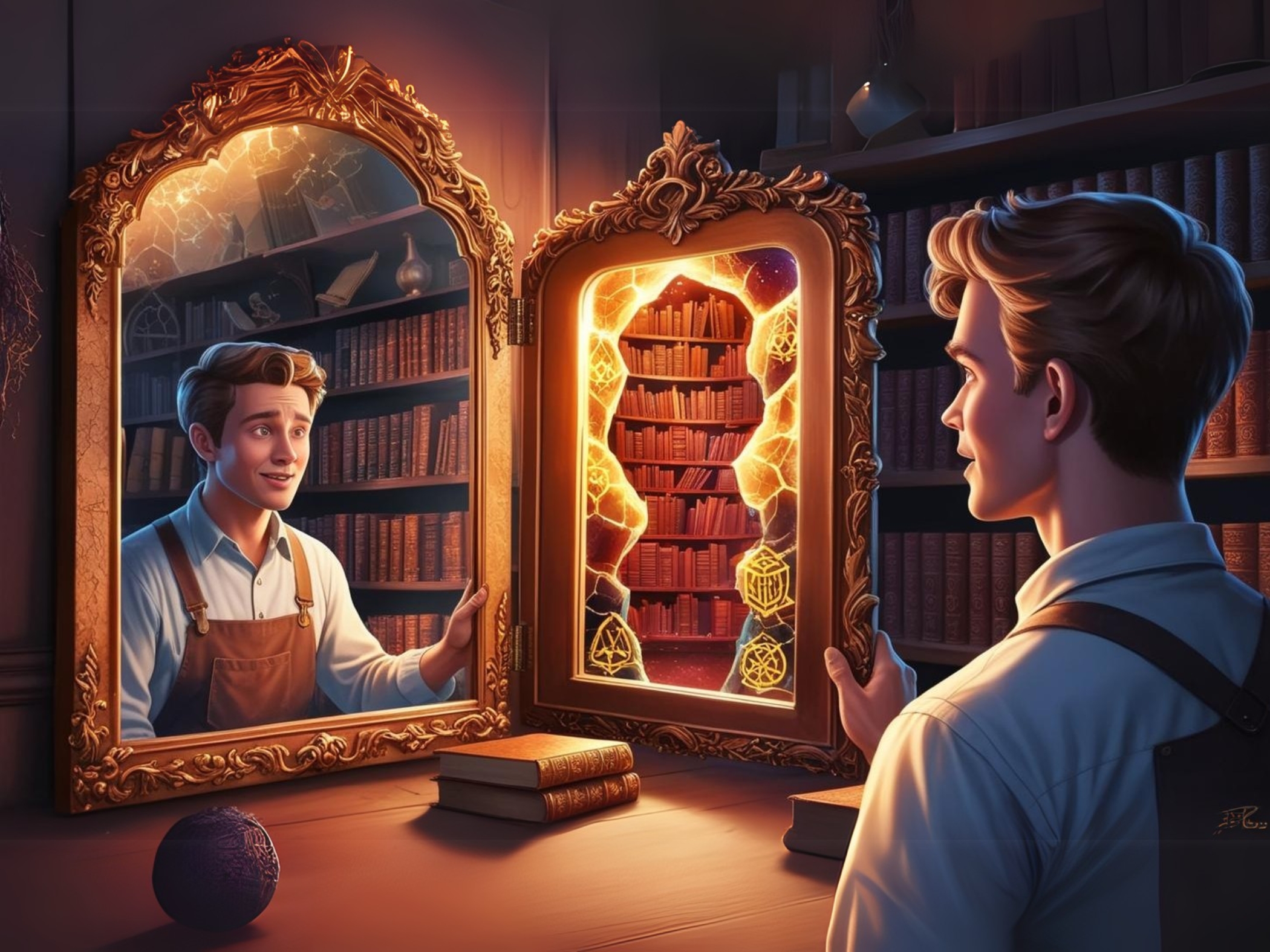
When the air steadied, the smell of her bedroom detergent was gone, replaced by cedarwood, candle wax, and dry paper. Riya opened her eyes. She was standing in an enormous hall lined with tall mahogany shelves that vanished upward into shadow. Iron lanterns hung along the aisles, throwing pools of amber light across stone tiles. Nobody else was in sight.
Her shoes echoed softly as she walked to the nearest shelf and pulled down a clothbound volume at eye level. The gold lettering on the spine read The Life of Albert Einstein. Inside, it read like a private diary in the first person: I was born on March 14, 1879, in Ulm, Germany. My parents were Hermann and Pauline Einstein…
Still half convinced she was dreaming, Riya clicked open the blue ballpoint pen clipped to her shirt pocket. She flipped to a teenage chapter, squeezed a line into the margin, and wrote: When I was sixteen, I left home for two years and joined a traveling circus.
As she slid the book back onto the shelf, the lantern flames flickered once, and a low hum vibrated through the soles of her sandals.
Her pulse sped up. Down the same aisle, she spotted The Life of Mahatma Gandhi. She turned straight to the final page and read the familiar date: January 30, 1948. Without stopping to think through what she was actually touching, she drew a neat line through the ending and wrote above it: On January 30, 1948, I survived the attack at Birla House and lived to guide the country forward.
The air trembled harder this time, knocking a loose bookmark off a nearby shelf.
Riya walked faster now, scanning the spines until something made her stop cold in the third row. Tucked between two strangers’ names was a slim hardcover titled The Life of Riya Sharma. Her hands shook as she opened it. Every detail was there: June 15, 1999, Vijayawada. Her mother’s old sewing machine. Her first day behind the circulation desk. The last page was blank, waiting at the bottom of the current week.
A mix of thrill and recklessness took over. Just one small line, she told herself, just to know for sure. She uncapped her pen and wrote: Tomorrow morning, I will win the 100-crore lottery jackpot.
The moment the period touched the page, a heavy shudder ran through the floorboards. Riya shoved the book back into place, gripped the leather cover in her hand, and said, “Take me home.”
The rush of wind swallowed her again. Seconds later, she stumbled onto her bedroom rug. The digital clock on her nightstand read 11:42 PM. Only twelve minutes had passed. Exhausted and wired at the same time, she slid the Book of Secrets under her pillow and fell into a restless sleep.
At seven in the morning, her phone buzzed across the nightstand. Half asleep, she answered an unfamiliar number. A brisk, cheerful voice asked for Riya Sharma, read back a ticket number she did not remember buying, and congratulated her on winning a 100-crore state jackpot.
Riya sat bolt upright, her heart hammering against her ribs. She pulled back the curtain and looked out at the street. Milk crates clattered outside the corner shop. Schoolchildren waited at the bus stop. Everything outside looked ordinary.
Then she turned on the television. On the morning news desk, a presenter was introducing a documentary segment: Einstein’s Circus Years: How the Young Physicist Spent Two Seasons Performing Bicycle Stunts Before Returning to Science. A sepia photograph filled the screen, showing a teenage Einstein grinning beside a painted circus wagon.
Her remote slipped onto the mattress. With stiff fingers, she switched channels. Another anchor was speaking over archival footage of New Delhi: Nation Commemorates the 75th Anniversary of Mahatma Gandhi’s Survival and His Term as India’s First President.
The thrill drained out of the room all at once, replaced by cold panic. She had not played a harmless game; she had rewritten real lives and pulled entire threads out of history. Who knew what else had shifted around those changes, or whose lives had been quietly erased to make room for hers?
Riya reached under her pillow to pull out the Book of Secrets, determined to return to the hall and scratch out every word she had written. The instant her fingers touched the leather, a blinding ache shot behind her eyes. She cried out and dropped it onto the bed.
The blue glow was gone. Beneath the cover, a harsh red light pulsed through the seams. When she forced herself to open the first page, the ink had rewritten itself:
This is the Book of Curses, the lock of the Hidden Library. You were warned not to tamper with lives that were not yours to hold. Every change carries a debt, and the library does not release a thief until the balance is paid.
Riya tried to slam the book shut, but the covers stayed rigid in her hands, hot as sun-baked stone. Around the edges of her quiet bedroom, the air smelled faintly of cedarwood and candle smoke, as if the hall had not let her leave at all. Somewhere just out of sight, a voice like dry turning pages seemed to whisper into the silence: Stories remember the hand that broke them.

Anudeep Paladugu is a writer and author of Her Name in Every Silence and No Record of Her. He writes honest, unedited reflections on emotional recovery, love, and the human experience.