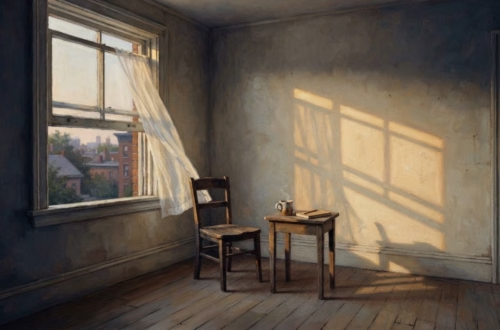

The brass key is small and slightly bent, sticking twice in the cylinder before the lock yields with a dry metallic click. When the door swings open, the room smells of aged plaster, floor wax, and the damp chill of late November. There is no furniture to soften the sound, so your footsteps echo against the skirting boards with an unsettling clarity, like someone walking through an empty gallery after closing hours.
You set two cardboard boxes down on the bare pine floor. A roll of brown packaging tape sits on the windowsill beside a paper coffee cup that has gone cold. Outside, twilight turns the street the color of bruised slate. Cars move slowly through the rain, their headlights washing across the ceiling in long, silent sweeps.
You sit down directly on the floorboards, pulling your knees up toward your chest, and look around.
Everything you currently own in this city is inside those two boxes, a nylon duffel bag by the radiator, and the trunk of a car parked three floors below on the asphalt. At twenty, this scene might feel like an adventure. You would tell yourself you were roughing it, building character, living like a poet on black tea and bread.
When you are thirty, forty, or fifty, an empty room does not feel romantic. It carries a heavy, unspoken weight that tastes like humiliation.
You were supposed to be past this stage. By now, according to every script handed down by family, school, and friends, you were supposed to stand on solid ground. You were supposed to own a dining table with matching chairs. You were supposed to be choosing kitchen tiles or checking mortgage rates, not calculating whether you can afford a bath towel and a laundry basket.
Life never asks for permission before pulling the rug. A marriage ends in cold law offices; a company folds and takes your loyalty with it; an illness drains your savings; or a single catastrophe shatters what took fifteen years to assemble.
Whatever the cause, the outcome is identical. The scaffolding has fallen away, and you are standing at the absolute beginning, holding an empty key ring.
The Quiet Humiliation of the Blank Slate
The hardest part of starting over from scratch is not the physical labor of hauling boxes or washing dishes in a sink. The hardest part is the private shame that follows you into the street.
Adulthood is built on accumulation. When you meet an old friend near the fruit stalls in a supermarket, the conversation follows a familiar rhythm: Where are you living now? How is work? How are the kids?
When you have lost everything, those innocent questions land like blows to the ribs. You stand there holding a bunch of bananas, trying to assemble a sentence that sounds respectable without telling an outright lie. You say you are between projects. You say you are taking some personal time. You smile until your cheek muscles ache, praying they do not ask for your address, because you cannot bear to explain that home is a studio apartment with water stains on the ceiling and a radiator that whistles at three in the morning.
Nobody wants to look at the messy, silent middle. Nobody wants to visit you when the floor is still bare, the walls are blank, and your eyes are bloodshot from staring at the dark.
In that silence, an insidious voice begins to whisper: You failed. You missed your turn. Everyone else understood the rules of the world, and you ruined the game.
When you are tired down to the marrow of your bones, failure feels like the only logical explanation for your empty hands.
When the Scaffolding Collapses
Yet if you sit still on those floorboards long enough, without reaching for your phone to numb the ache or inventing a frantic plan to salvage your reputation, you begin to notice something strange about the silence.
For the first time in your adult life, there is nothing left to protect.
Think about how much energy over the last decade was spent defending an illusion: the title on your business card, the appearance of a happy union, or the expectations placed on your shoulders before you even knew who you were. You were a soldier guarding a fortress of obligations, terrified that one loose brick would reveal the panic inside.
The fortress has crumbled. The brickwork is gone. The spectators who clapped for your success have drifted off, and the critics who doubted you have already moved on to their next judgment.
You are left with only what is real: your breath, your pulse, and the quiet dignity of having survived the very collapse you spent years dreading.
The Wisdom of the Fallow Season
The ancient world understood something about collapse that our modern striving has forgotten: an empty field is not a cemetery. It is simply ground that has been cleared for a different planting.
In agriculture, there is a practice known as leaving the soil fallow. After seasons of intense harvest, the land becomes depleted. It cannot yield another crop without exhausting itself into barrenness. A wise farmer does not panic when the field sits brown and quiet under winter clouds. He does not demand that the frozen dirt produce wheat in December. He lets it rest. The rain soaks deep into the loam; the earth gathers its strength in total obscurity.
Starting over from zero is your fallow season.
It does not mean you are broken or finished. It means the old way of growing ran its course and wore itself out. You cannot force a new life to bloom on a Thursday afternoon just because you feel embarrassed about being empty-handed. The soul moves at the pace of winter grass: slow, deliberate, and entirely hidden from public view.
Rebuilding with Honest Hands
When you begin to rebuild from nothing, your relationship with ordinary things undergoes a profound change.
You buy a single ceramic mug from a corner thrift store, a sturdy blue one with a small chip near the base. You bring it home, wash it with hot water, and set it on the counter. When you pour hot water over a tea bag and wrap your fingers around the warm glaze, that single cup feels more precious than the entire cabinet of matching porcelain you used to own.
You buy a wooden chair, a wool blanket, and a small desk lamp with a paper shade. Each object is chosen with care, not to impress a dinner guest, but because it serves your life. You begin to appreciate the quiet miracle of hot running water, the comfort of clean sheets, and the steady companionship of morning sunlight sliding across the pine boards.
You also begin to choose your company with ruthless tenderness.
When you have nothing material to offer, you quickly discover who loves you for your presence and who only loved you for your convenience. The friends who come to sit with you on the bare floor, who bring two paper cups of coffee and do not ask when you are going to get your act together, are the ones who belong in your next chapter.
Rebuilding from scratch teaches you a secret that comfortable people rarely learn: freedom is not having everything you want. Freedom is discovering that you can lose almost everything you thought was essential, and still find reasons to greet the morning with curiosity.
A Quiet Grace for the Morning
True beginnings are modest. They happen without an audience.
They happen when you sweep the dust from the corners of an empty kitchen and feel a quiet satisfaction in the clean wood. They happen when you write a single true sentence in a notebook and close the cover without checking for approval. They happen when you look out at a gray November drizzle, feel the cool air against your face, and realize that you are still here, breathing, capable of kindness, and ready to take one small, unhurried step.
Tonight, if you are sitting on an unmade floor somewhere, feeling the chill seep through your socks and wondering how life brought you back to the beginning, take heart.
You have not been discarded. You have simply been given a clean slate, stripped of pretension and hollow noise. Lay your head down on whatever pillow you have. Let the room go quiet. Tomorrow will bring its own work, and you will meet it with two honest hands.
A Quiet Companion for Grief & Healing
If you are standing in an empty room, learning how to start over from scratch and rebuild your life with honest hands, explore Anudeep Paladugu’s poetry and prose collection, Her Name in Every Silence.

Anudeep Paladugu is a writer and author of Her Name in Every Silence and No Record of Her. He writes honest, unedited reflections on emotional recovery, love, and the human experience.