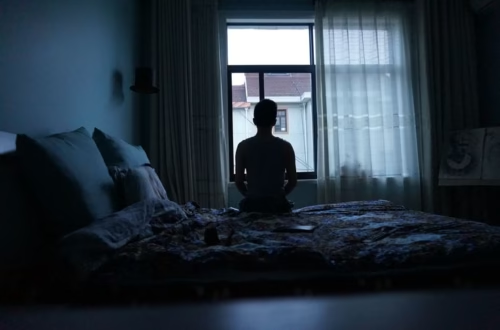

You know that feeling when everything in your life is actually going pretty well, but there’s this nagging sensation in your chest that won’t go away? When you’re lying in bed at night, scrolling through your phone, and suddenly your heart starts racing for absolutely no reason? When people ask how you’re doing and you say “great!” because objectively, things are great, but inside you feel like you’re waiting for the other shoe to drop?
Yeah, me too. And honestly, it’s one of the most confusing feelings in the world.
I used to think I was broken. Like, seriously, what kind of person gets anxious when things are going well? Shouldn’t anxiety only show up when there’s actually something wrong? When you’re facing a deadline, or dealing with a breakup, or going through some obviously stressful situation? That’s when anxiety makes sense, right? But feeling anxious when you’ve got a job you like, relationships that are healthy, and no major crisis on the horizon? That just felt wrong. It felt ungrateful. It felt like I was manufacturing problems out of thin air.
But here’s what I’ve learned, and what I wish someone had told me years ago: yes, it is completely, utterly, frustratingly normal to feel anxious even when life is good. In fact, it’s way more common than we talk about.
Think about it this way. Anxiety isn’t always a logical response to external circumstances. It’s not like a smoke alarm that only goes off when there’s actually a fire. Sometimes anxiety is more like that car alarm that goes off randomly at three in the morning because a cat walked by. The system is just sensitive. And our brains? They can be incredibly sensitive.
The thing is, we’ve been conditioned to believe that our emotions should match our circumstances. Good life equals happy feelings. Bad life equals sad or anxious feelings. It’s this neat little equation that makes sense on paper but completely falls apart in real life. Because humans are complicated. Our brains are complicated. And the relationship between what’s happening around us and what’s happening inside us is way more tangled than we’d like to admit.
I remember this one period in my life when everything was genuinely good. I’d just gotten a promotion at work. My relationships with friends and family were solid. I’d even started working out regularly, which was basically a miracle. On paper, I was crushing it. But every morning, I’d wake up with this tight feeling in my chest. This sense of dread that I couldn’t name or explain. I’d catch myself catastrophizing about things that hadn’t happened and probably never would. And the worst part? I felt guilty for feeling this way.
Because when life is good and you’re still anxious, you start to feel like you’re doing something wrong. Like you’re broken, or weak, or not trying hard enough to be happy. You look around at all the good things in your life and think, “Why can’t I just enjoy this? What is wrong with me?” And then the anxiety about being anxious kicks in, and suddenly you’re in this spiral that feels impossible to escape.
But here’s the truth that took me way too long to understand: anxiety doesn’t always need a reason. Sometimes it’s just there, like background noise. It can be biological, running through your family like brown eyes or curly hair. It can be the result of past experiences that taught your brain to be hypervigilant. It can be about how your body processes stress hormones, or how much sleep you got last week, or whether you’ve been drinking too much coffee. Sometimes anxiety is just a thing your brain does, regardless of what’s happening in your life.
And you know what else? Sometimes anxiety shows up precisely because things are going well. I know that sounds backwards, but stay with me. When life is good, we have more to lose. We become aware of how fragile happiness can be. We start waiting for something to go wrong because, in our experience, good things don’t last forever. It’s like we’re so unused to stability that we don’t trust it. Our brains, trying to protect us, start scanning for threats. What if I lose my job? What if this relationship ends? What if something bad happens to someone I love? The anxiety becomes a twisted form of preparation, as if worrying now will somehow cushion the blow if something bad does happen later.
There’s also this weird thing where peace can feel unfamiliar, almost uncomfortable, if you’ve spent a lot of your life in chaos or stress. Your body gets used to running on high alert. That becomes your normal. So when things calm down and life gets good, your system doesn’t know what to do with the quiet. It feels wrong. Suspicious. And so your brain creates something to worry about because at least that feels familiar.
I’ve also noticed that when life is good, we have more mental space to actually notice our anxiety. When you’re in crisis mode, dealing with real problems, you’re too busy handling things to pay attention to the background hum of worry. But when the big problems clear away and you’re left with just regular life, suddenly you have the bandwidth to notice that your heart is racing, that your thoughts are spinning, that you’re not as calm as you thought you’d be once things got better. The anxiety was probably always there; you just couldn’t hear it over everything else.
And let’s talk about the comparison trap for a second, because it makes everything worse. We look at other people who seem to have lives similar to ours, and they appear happy and content and anxiety-free. We scroll through social media and see everyone’s highlight reels and think we’re the only ones feeling this way. But here’s what I’ve learned from actually talking to people: almost everyone is dealing with something. Almost everyone has moments where they feel anxious for no clear reason. We’re all just really good at hiding it and pretending we have it together.
The guilt that comes with anxiety during good times is real and heavy. It feels selfish to be anxious when you know there are people dealing with genuinely difficult situations. It feels like you’re wasting your good fortune by not being able to fully enjoy it. But emotions don’t work on a comparative scale. Your anxiety isn’t less valid just because someone else has it worse. Your feelings matter regardless of your circumstances. And beating yourself up for feeling anxious only adds another layer of suffering on top of the anxiety itself.
So what do we do about it? How do we handle anxiety that shows up uninvited when life is actually going okay?
First, we stop fighting it so hard. I know that sounds counterintuitive, but resistance often makes anxiety worse. When we tell ourselves we shouldn’t feel this way, that we’re being ridiculous, that we need to just snap out of it, we’re adding judgment on top of an already uncomfortable feeling. Instead, what if we just acknowledged it? “Okay, I’m feeling anxious right now. I don’t know why, and that’s okay. This is just what’s happening in my body at this moment.”
Second, we get curious instead of critical. Instead of asking “What’s wrong with me?” we can ask “What might this anxiety be trying to tell me?” Maybe it’s letting us know we need to slow down. Maybe it’s pointing to something we need to address, even if that something isn’t obvious. Maybe it’s just a sign that we need to take care of ourselves, get some rest, or talk to someone. Anxiety can actually be information, even when it feels irrational.
Third, we build a toolbox. Not to eliminate anxiety completely, because that’s not always realistic, but to make it more manageable. For some people, that’s therapy. For others, it’s exercise, or meditation, or journaling, or just talking to friends who get it. It’s figuring out what helps your particular brain calm down a bit. And understanding that what works might change, and that’s okay too.
Fourth, we practice being present. Anxiety loves to pull us into the future, making us worry about things that haven’t happened yet. But right now, in this moment, are you actually okay? Is there an actual threat right now, or is your brain just spinning scenarios? Sometimes the most powerful thing we can do is come back to right now, to this breath, to this moment, and recognize that in this moment, we’re okay.
And maybe most importantly, we talk about it. We normalize it. We stop pretending that good circumstances automatically equal good feelings. We let other people know they’re not alone in this weird experience of feeling anxious when they “shouldn’t” be. Because the more we talk about it, the less power the guilt and shame have over us.
Look, I’m not going to tell you that understanding all of this makes anxiety disappear. It doesn’t. I still have days when everything is fine and I feel like I’m vibrating with worry for no reason. But what’s changed is that I don’t add the layer of self-judgment anymore. I don’t spiral into “what’s wrong with me” quite as much. I can recognize it for what it is—just anxiety doing its thing—without making it mean something about my worth or my gratitude or my ability to appreciate my life.
You are not broken. You are not ungrateful. You are not doing life wrong. You’re just human, with a human brain that sometimes gets anxious, regardless of circumstances. And that’s okay. It really is. The anxiety doesn’t negate the good things in your life, and the good things in your life don’t invalidate your anxiety. Both can be true at the same time.
So the next time you’re lying there at night, life objectively good, anxiety still humming in your chest, remember: you’re not alone. This is normal. This is human. And you’re doing better than you think you are, even when it doesn’t feel like it.